Feeds:
Posts
Comments

Saints, “Saints”

I listened to her stories about her team with a mix of pity and fascination. It was the first time I saw fandom as a form of faith rather than a method for receiving a regularly scheduled reward.

This pleasing two-paragraph mini-essay includes a link to James Brown’s cover of “When The Saints Go Marching In.” Which is pretty bad. But the essay is good. Check it out.

I remember reading or hearing an interview with Allen Toussaint in which he dispelled the assumption that the music on his most recent record, being jazz standards, is stuff he grew up playing. After all, just because he’s from New Orleans doesn’t mean he had to be a jazz expert, or for that matter a jazz fan. Still, this is interesting:

Toussaint had never heard “Dear Old Southland,” “Singin’ the Blues” and Django Reinhardt’s “Blue Drag” before [producer Joe] Henry suggested them.

And:

Incredibly, Toussaint had never played the New Orleans standard “St. James Infirmary” before recording it for “The Bright Mississippi.”

“I knew it existed and I heard other people playing it. But remember, I was busy writing songs most of my time. And the gigs that I played were generally rock ‘n’ roll or rhythm & blues. Of course, we all know ‘St. James Infirmary’ and can play it if we’ve never played it before. Some songs are so well written, that’s how they are.”

Super Beauxl Sunday

"Hu Dat?" Pies. Pic by G.K. -- Thanks!

I already knew this would have been a great week to be in New Orleans as the city got ready for the big game, but this WSJ story, New Orleans Takes A Week Off, drove it home:

Pre-Mardi Gras parades have been rescheduled. Some restaurants are closing on a non-holiday for the first time. Sunday evening Mass is canceled across much of the city, with the blessing of the local archbishop.

In moving the start date of a civil trial from earlier this week to Feb. 9, Parish of Orleans Judge Michael G. Bagneris wrote in an order that he “takes judicial notice that Saintsmania permeates the City of New Orleans.”

Also area schools are taking tomorrow off, and of course everybody ignored the mayoral election. (Landrieu won.)

Enjoy the game…

Beads

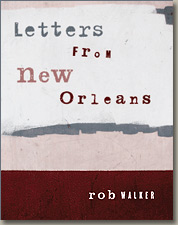
In one of the essays in Letters From New Orleans, I made passing mention of the origins of Mardi Gras beads — murky, made in China, and beyond that I didn’t want to know the details, if you know what I mean.

Well, someone else did want to know the details.

MARDI GRAS: MADE IN CHINA follows the story of four teenage workers who sew plastic beads together with needles and thread and also pull them from a machine. Each story provides insight into their economic realities, self-sacrifice, dreams of a better life, and the severe discipline imposed by living and working in a factory compound.

More here.

Six Seconds From 1969

This fascinating, brilliant 20-minute video narrates the history of the “Amen Break,” a six-second drum sample from the b-side of a chart-topping single from 1969. This sample was used extensively in early hiphop and sample-based music, and became the basis for drum-and-bass and jungle music — a six-second clip that spawned several entire subcultures. Nate Harrison’s 2004 video is a meditation on the ownership of culture, the nature of art and creativity, and the history of a remarkable music clip.

Via Retro Thing.

Mr. Okra

Looks like this is both a stand-alone short to show at Sundance, and also part of a planned longer doc called The Other Side of Rampart. My view is they go too far with the subtitles, as he’s not that hard to understand, and the effect is to make him seem more distant (foreign?) than necessary. But the production values are fantastic and it’s an obvious labor of love — plus Mr. Okra is a very beloved N.O. figure. So all in all: Big ups.

Thx: Charles.

The melting-pot factor

What makes American music American?

Leonard Bernstein gives his answer to the question, in introducing a performance of Aaron Copeland’s “Fanfare for the Common Man” (conducted by Copeland himself, no less) in 1958. In short, he says it’s the nation’s “many-sidedness,” “all the races and personalities from all over the globe that make up our country.”

When we think of that, we can understand why our own folk music is so complicated. We’ve taken it all in … and learned it from one another. Borrowed it, stolen it, cooked it all up in a melting pot….

His full introduction and articulation of this goes on for a couple of minutes, and is worth checking out.

Via BoingBoing.

Art of “SJI.”

A great tip from our friend Robert W. Harwood:

Artist Gareth A. Hopkins is working on a series of postcards, each interpreting one line of “St. James Infirmary.” He’s completed verse one and chorus one so far, and needless to say I’m looking forward to seeing more, and hoping it turns out there turns out to be a way for me to obtain a set.

Mr. Hopkins’ deviantART shop is here. Links to more of his work can be found at his blog.

I went down to St. James Infirmary,
Saw my baby there.
She was stretched out on a long white table, so sweet,
So cold, so bare.

Let her go, let her go, God bless her,
Wherever she may be,
She can search this whole wide world over,
She ain’t never gonna find another man like me.

In the badly-in-need-of-updating essay I wrote about “SJI” a few years ago, I went on and on about how the song’s opening passages in the version that’s most commonly heard in New Orleans — above — is a major part of what captivates me: the singer beholds his dead lover, and promptly declares that “She can search this whole wide world over; she ain’t never gonna find another man like me.” Since I’m practically self-plagiarizing, I may as well just resort to quoting myself:

That passage I’m so obsessed with does not appear in the old English “Rake” songs, nor is it in either version of the lyrics provided by Sandburg, or in McTell’s version. In one of the sets of lyrics that Sandburg offers, the line is replaced with, “There’ll never be another like her; there’ll never be another for me.” This is the way the Hall Johnson Negro Choir did it in December 1931, and it’s also the reading that Bobby Bland went with decades later. It’s certainly a more traditional and less jarring sentiment. And it’s much less interesting.

The line is omitted from Fess Williams’ 1927 take, which skips straight from the image of the dead woman to the narrator discussing his own funeral…

The references there are several. Most notably, the “Rake” songs refers to the line of songs stretching back, perhaps, to Ireland in 1790. The root song, “The Unfortunate Rake,” concerns a man lamenting that his lover has given him syphilis. It’s a scenario that naturally raises the subject of betrayal, and of the singer’s own demise as a result of it. “Streets of Laredo” is the more obvious descendant of this song cycle, but “SJI” is often described, by me among others, as a kind of spinoff or offshoot. Robert W. Harwood’s I Went Down To St. James Infirmary teases out a more detailed history of the “SJI” we all know and love today. In particular, he zeroes in on the creation of the song “Gambler’s Blues,” credited to Carl Moore and Phil Baxter (and recorded by Fess Williams in 1927), that is pretty darn close to the song that Louis Armstrong recorded in 1928 , and that was later attributed to “Joe Primrose” (Irving Mills). Please see Mr. Harwood’s book for details, because I can’t do the whole story justice here, and I have something else I want to say.

What I want to say concerns that “Let her go” bit. And I guess I should warn you that this is a very, very long post. Continue Reading »

Rules regarding The Saints

WSJ has this amusing bit in a FAQ about the NFL playoffs:

Q: May I root against the New Orleans Saints?

A: No, you may not. Rooting against the Saints is like rooting against Elin Nordegren. They’re the Sentimental Team of the Century; if Dick Enberg were calling the NFC championship game, he’d need a trailer truck of Kleenex. Even if you forget everything that New Orleans endured during Hurricane Katrina—and how could you?—they’re the Saints, the former Aints, one of the most hard-luck franchises in the history of hard luck. Not long ago, newborns came into the world in New Orleans hospitals with tiny grocery bags on their heads.

If the Saints win this weekend, we expect the Louisiana Superdome to levitate off the ground, stop at Parkway Bakery & Tavern for a roast beef po’boy and fly straight to Miami for the Super Bowl.

And later:

Q: Is anyone really rooting for the Colts to win the Super Bowl, other than the city of Indianapolis and Peyton Manning’s dad, Archie?

Don’t be ridiculous. Archie Manning’s rooting for the Saints.

Older Posts »